


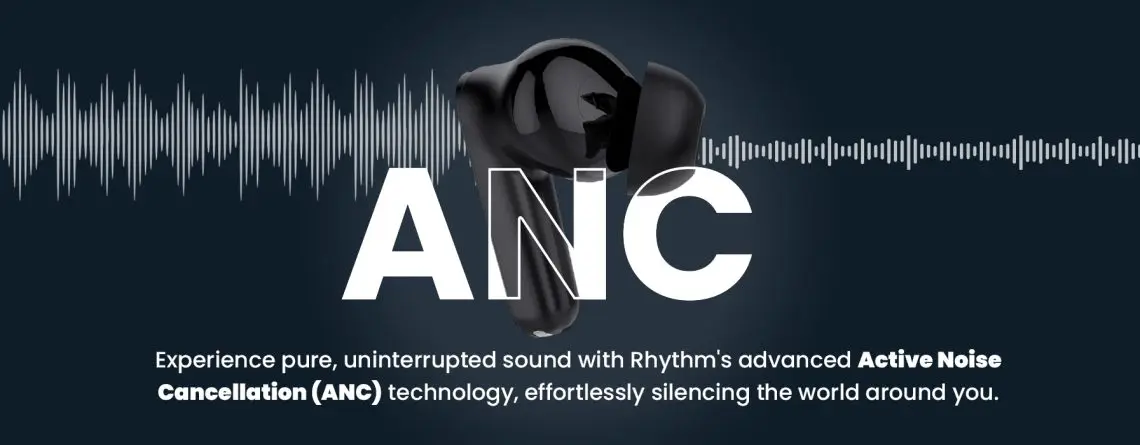
Active Noise Cancellation (ANC) is a technology used in modern audio devices, especially headphones and earbuds, that actively reduces unwanted ambient sounds. Unlike passive noise isolation, which blocks noise by sealing your ears, ANC uses a combination of microphones and digital processing to “cancel out” the noise before it reaches your ears.
Here’s how it works: ANC-equipped devices detect incoming sound waves from your environment and then generate an “inverse” sound wave with the same amplitude but an opposite phase. When these two sound waves, one from the environment and one from the device, meet, they interfere and cancel each other out. The result is a significant reduction in background noise, especially constant, low-frequency sounds like an engine’s hum or an air conditioner’s drone.
Why It Is Essential in Today’s Noisy Environments
The demand for Active Noise Cancellation has surged as our daily environments grow increasingly chaotic. Whether working remotely from a coffee shop, commuting on public transport, or simply trying to concentrate in a shared office, background noise can be distracting and stressful.
It provides a form of personal escape. It allows you to create a sonic bubble that shields you from the world’s noise. For example, frequent flyers can use ANC headphones to reduce the engine rumble on flights. Students can study in louder environments. Office workers can focus better even in open-plan layouts.
Additionally, it helps protect your hearing. Without noise cancellation, many people instinctively turn up the volume to drown out background noise, which can be harmful over time. By reducing the noise floor, ANC enables you to listen at lower, safer volume levels without compromising clarity or detail.
The Rise of Noise-Cancelling Earbuds and Headphones
A decade ago, travelers and audio professionals primarily found Active Noise Cancellation in high-end over-ear headphones. It’s become a mainstream feature, even in compact, affordable wireless earbuds.
The push toward portability and convenience, combined with advances in chipsets and miniaturised microphones, has led to the development of lightweight earbuds that offer impressive ANC performance. Brands from Apple and Sony to budget-focused newcomers now compete in the wireless and noise-cancelling earbuds category, offering models with adjustable Active Noise Cancellation, transparency modes, and adaptive environments.
This rise isn’t just about sound quality. It reflects how modern lifestyles have shifted. With hybrid work, online learning, increased travel, and growing noise pollution, ANC isn’t just a premium bonus anymore—it’s an everyday essential.
How Does Noise Cancellation Work in earbuds & headphones?
External Microphones Detect Surrounding Noise
ANC technology begins with microphones—usually multiple- located inside and outside the earcup or earbud. These mics constantly monitor your environment, picking up ambient sounds such as traffic, fans, airplane engines, or background chatter.
The effectiveness of this first step is critical. The microphones’ quality, placement, and sensitivity determine how accurately the system can detect and analyze external noise. High-end ANC models typically include feedforward (external) and feedback (internal) microphones for a more complete picture of the soundscape.
Digital Signal Processing (DSP) Creates Inverse Waves
Once the microphones collect ambient noise, the data is passed to a digital signal processor (DSP). This chip calculates the opposite waveform—a mirror image of the noise.
This “anti-noise” is then played through the speakers of the earbuds or headphones, and at the same time, the external sound hits your ears. The incoming noise and the inverse waveform cancel each other out through destructive interference.
This happens in real time—hundreds or thousands of times per second. The DSP must be fast and precise, so ANC performance often depends on how advanced the internal processing chip is.
ANC Works Best Below 1000 Hz
One of the most critical technical realities to understand is that ANC is most effective at canceling sounds in the low-frequency range, typically below 1000 Hz. These frequencies include:
- Airplane engine hums
- Traffic noise
- HVAC systems
- Low droning machinery
This frequency range is easier for ANC systems to predict and invert because the waveforms are longer and more stable over time. In contrast, high-frequency sounds—like clinking silverware, human speech, or sudden loud bursts—are more erratic, difficult to track, and cancel effectively.
You may still hear voices or keyboard clicks even with ANC turned on. The system isn’t broken; it’s just working within the limits of acoustic physics.
Differences in ANC Between Earbuds and Headphones
The form factor of a device heavily impacts its ANC performance.
Headphones, especially over-ear models, have the physical space to include larger drivers, more microphones, and more powerful DSPs. Their earcups also offer better passive noise isolation, complementing the active system.
Earbuds, by contrast, are more compact. While they benefit from tight in-ear seals that provide some passive reduction, they typically can’t match the raw ANC power of full-size headphones. However, innovations like custom ANC chips and adaptive noise cancelling have narrowed this gap significantly in recent years.
Still, if your primary goal is top-tier noise cancellation for long-haul flights or office work, over-ear headphones will perform better. But for casual use, workouts, or commuting, today’s premium earbuds are impressively capable.
Battery Life Impact
ANC doesn’t come without trade-offs, and battery life is one of its most significant costs.
When ANC is turned on, the microphones and DSP run continuously, consuming more power than when listening to music or taking calls. On average, using ANC can reduce battery life by 20–30%, depending on the model and use case.
Some earbuds offer ANC modes with variable intensity, allowing you to scale down noise cancellation when full power isn’t needed. Others include auto-off features that deactivate ANC when you’re not wearing them. Nevertheless, monitoring battery levels and carrying a charger or case with backup power is good if you plan long listening sessions.
How Is ANC Performance Tested? + Real Limitations
Active Noise Cancellation (ANC) technology may sound like magic, but it’s deeply rooted in acoustic science, signal processing, and precise engineering. Brands often advertise how many decibels (dB) their ANC headphones can “cancel,” but what do those numbers mean? How are they measured? And more importantly, how does that lab-based performance translate to the real world?
This section looks at how ANC performance is tested, what metrics are used, and what factors can significantly affect the experience for everyday users.
Lab-Based Testing: Controlled Simulations of Noise
ANC testing begins in laboratory environments, typically inside specially designed rooms known as anechoic chambers. These spaces are acoustically isolated to eliminate external sounds and reflections, creating a clean slate for controlled experiments. Engineers use speakers to play a consistent test noise—like white noise or low-frequency hums—at a known sound pressure level (SPL), usually in the 60–90 dB range.
A dummy head and torso simulator (HATS) is often used during testing. This mannequin mimics a real human head’s size, shape, and acoustic response, including a molded pinna and ear canal. Headphones or earbuds are placed on the dummy, and a reference microphone is embedded in the artificial ear canal to measure what sound actually gets through after ANC is applied.
The key metric here is attenuation, which refers to how much the ANC reduces the original noise. It is measured in decibels (dB) across a frequency spectrum—commonly from 20 Hz to 20,000 Hz. Engineers compare two recordings:
- The sound inside the ear is heard without ANC active.
- The sound inside the ear is with ANC enabled.
The difference between these two recordings across various frequency bands shows how effective the ANC system is. For example:
- A 30 dB drop at 200 Hz would indicate excellent performance in low-frequency noise cancellation.
- A 10 dB drop at 3000 Hz would suggest a limited impact on mid-frequency sounds like human voices.
Frequency Response: Where ANC Works Best
Through this testing, one fact becomes clear: ANC works best in the low-frequency range—typically below 1000 Hz. It includes sounds like:
- Airplane engine noise (around 100–500 Hz)
- HVAC systems and fans (around 60–200 Hz)
- Road and tire noise (below 800 Hz)
These sounds are relatively steady, long-wavelength, and predictable, making them ideal for real-time cancellation using inverse waves. As frequency increases, however, ANC performance drops off. That’s because
- High-frequency sounds (like speech, door slams, or barking dogs) change rapidly in amplitude and timing.
- The inverse waveform would need to adjust instantaneously, which is technically challenging and computationally expensive.
In short, ANC is designed to handle “droning” noise, not “sudden” noise. So even in the best ANC systems, you’ll still hear abrupt sounds like keyboard clicks, honking, or conversations—especially at close range.
Real-World Performance: Ear Fit, Seal, and Movement Matter
Lab-based tests are valuable, but they don’t tell the whole story. Real-world ANC performance varies dramatically depending on user-specific factors, including:
- Ear fit: Loose-fitting earbuds allow more ambient noise to leak, making ANC less effective. The better the seal, the better the results.
- Tip material and design: Foam tips provide better passive isolation than silicone, helping ANC systems work more efficiently.
- Head shape and size: Even the best over-ear headphones can struggle to form a perfect seal around the ears on specific head shapes.
- Movement: Walking, chewing, or adjusting the device can shift the microphones or compromise the seal, temporarily reducing performance.
Environmental factors also affect ANC quality. For example, using ANC in a quiet room might actually introduce a faint hissing or pressure-like sensation—caused by the system trying to cancel non-existent noise. In contrast, ANC shines in planes, trains, or crowded spaces with consistent ambient hum.
Performance Range: Budget vs Premium Devices
Let’s talk numbers. In lab conditions:
- High-end ANC headphones like the Sony WH-1000XM5 or Bose QuietComfort Ultra can reduce up to 40–45 dB in the low-frequency range.
- Mid-tier devices like the Apple AirPods Pro typically reach around 25–30 dB of reduction under optimal conditions.
- Budget ANC earbuds, especially under $100, may only manage 15–20 dB, and their effectiveness may depend heavily on fit.
To give context: a 10 dB reduction halves the perceived loudness of sound. The difference between 20 dB and 40 dB of se cancellation can be tolerable and peaceful.
Also, some premium ANC systems offer adaptive ANC or multi-stage ANC, which fine-tune performance in real time using internal gyroscopes, barometers, or environmental scanning. These features can adjust the ANC profile based on whether you’re stationary, walking, in transit, or in a windy area.
Limitations: What ANC Can’t Do
Despite significant advancements, ANC has hard limits, both physical and perceptual:
- High-Frequency & Impulsive Noise: ANC cannot respond fast enough to cancel out sudden, high-pitched sounds. Speech, keyboard typing, and loud bangs are too erratic for effective cancellation.
- Latency & Processing Delay: Although modern processors are fast, there’s still a microsecond delay between detecting noise and generating the anti-noise. This delay limits how well it can adapt to dynamic environments.
- Audio Artifacts: In some models, ANC may introduce mild distortions, hissing, or a sense of “pressure” in the ears. While not harmful, it can feel odd—especially in ultra-quiet settings.
- Transparency vs Isolation Trade-Off: You can’t have it all. If you’re using transparency mode (to hear surroundings), ANC is wholly or partially disabled. Some devices offer hybrid modes, but awareness and silence are always a trade-off.
Battery Dependency: ANC systems rely on continuous power. When your battery dies, ANC turns off—and in some cases, audio playback is turned off altogether.
The Cost Factor: Why ANC Raises the Price
ANC isn’t just software—it’s a complex integration of specialized hardware and firmware:
- Multiple microphones, both inside and outside the ear
- Dedicated ANC chips, separate from your device’s central audio processor
- Digital signal processing algorithms that must run continuously with minimal delay
This added hardware increases production cost and complexity, so true ANC devices are typically more expensive. Moreover, tuning ANC systems for consistent performance across thousands of users requires extensive testing, firmware updates, and long-term support.
Some brands try to cut corners with “hybrid ANC” or “basic ANC” labels, which may only use a single microphone or limited processing. The result is often weaker performance, especially in unpredictable environments.
ANC vs ENC: What’s the Real Difference?
Active Noise Cancellation (ANC) and Environmental Noise Cancellation (ENC) are often used in product specs. At first glance, they sound similar—both are designed to “cancel” noise. However, they serve very different purposes, and knowing the distinction can help you pick the correct device for your needs.
ANC is listener-focused. It enhances your personal audio experience by reducing the ambient sound that reaches your ears.
As explained earlier, ANC relies on:
- Microphones that detect external sounds
- A digital signal processor that generates inverse sound waves
- Destructive interference, which cancels out ambient noise before it reaches your ears
ANC is used when you want to listen better to music, podcasts, or just silence. It creates a quieter environment for the listener, making it ideal for flights, buses, coffee shops, or open-plan offices.
What is Environmental Noise Cancellation (ENC)?
ENC is microphone-focused. It’s a technology designed to improve the clarity of your voice during phone calls or online meetings—especially in noisy environments.
Here’s how it works:
- When you speak into your device’s microphone, ENC uses multiple microphones to isolate your voice from background noise.
- It applies digital filtering to suppress ambient sounds such as wind, traffic, fan noise, or people talking nearby.
- The result is a cleaner, crisper version of your voice sent to the person on the other end of the call.
ENC is especially useful in earbuds and Bluetooth headphones for calls while walking, commuting, or working in shared spaces. Unlike ANC, ENC doesn’t affect what you hear—it only processes what the other person hears from your mic.
Real-World Use: ANC vs ENC
Let’s look at real-world scenarios to clarify which technology is at play.
Scenario 1: You’re on a Zoom call while walking down a busy street.
- If turned on, ANC helps you hear them better by blocking out the same noise—but this is optional.
- ENC is hard at work here. It filters out wind, car horns, and chatter so your voice sounds clean and professional to your teammates.
Scenario 2: You’re sitting in an airplane, listening to music.
- ANC shines in this situation. It cancels the constant engine hum to enjoy your music or rest.
- ENC is irrelevant unless you’re making a call.
Common Misconception: ANC Doesn’t Block Everything
Many people believe that ANC means total silence—but that’s a myth.
While ANC can significantly reduce steady, low-frequency noise, it struggles with:
- Human speech
- Sudden loud sounds
- High-frequency interruptions like doorbells or clattering dishes
It is not a flaw—it’s a limitation of the physics involved. ANC systems work best when the external noise is consistent and predictable. So if someone’s talking next to you at the office, you’ll likely still hear them—though less prominently.
To get complete isolation from voices or sharp sounds, you need a combination of:
- Passive Noise Isolation (tight ear seals or over-ear cups)
- ANC (for the hums and rumbles)
- Loud audio (masking residual noise)
Adaptive ANC: Smarter Noise Control Based on Environment
One of the latest innovations in ANC tech is Adaptive ANC, which uses intelligent algorithms to adjust noise-cancelling levels in real-time based on where you are and what you’re doing.
For example:
- Sitting in a quiet room? The ANC might dial down to avoid that “ear pressure” feeling.
- Step outside into a noisy street? The ANC automatically increases in strength.
- Walking or jogging? The earbuds may balance ANC and transparency Mode to keep you safe while reducing distractions.
These systems rely on a mix of:
- Accelerometers (to detect motion)
- Internal processors (to adjust response in milliseconds)
- Microphones (to measure ambient noise)
Some earbuds even allow users to adjust ANC levels, offering modes like manual:
- Full ANC
- Comfort ANC (less intense, for indoor use)
- Transparency Mode (lets outside sounds in)
- Adaptive Mode (automatically toggles based on context)
Adaptive ANC adds another layer of comfort and practicality, especially for people moving through different environments throughout the day.
Noise Cancellation vs Noise Reduction: Are They the Same?
Many consumers confuse noise cancellation and noise reduction; understandably, the terms sound similar. But technically, they refer to very different approaches to minimizing unwanted sound. Understanding the difference is crucial when choosing audio devices that fit your lifestyle.
Active Noise Cancellation (ANC): Canceling with Technology
Unlike PNR, Active Noise Cancellation is an electronic method of reducing noise. As we’ve covered, it uses:
- External microphones to listen to environmental sounds
- A digital processor to generate anti-noise signals
- Speakers to play those signals in real time
ANC is most effective at cancelling low-frequency, constant sounds. It does not work well for sudden or erratic noises unless paired with strong passive sealing.
Passive Noise Reduction (PNR): Isolation by Design
Noise reduction, or passive noise isolation, involves physical barriers that block or dampen incoming sound waves. It is done through:
- Tight-fitting ear tips (in earbuds)
- Over-ear cushions that fully seal your ears (in headphones)
- Use of dense materials like memory foam or silicone
These elements don’t rely on power, microphones, or signal processing. They’re always active. Think of them as a soundproof wall between you and the environment.
Passive noise reduction is especially effective at blocking mid to high-frequency noise—like voices, barking dogs, or clicking keyboards. Many musicians and sound engineers use high-quality passive headphones for studio work.
However, PNR struggles with low-frequency noises like engine rumbles or HVAC drones. That’s where ANC becomes useful.
Why the Combination Works Best
In a well-designed pair of earbuds or headphones, both systems work together:
- Passive isolation blocks out voices and sharp sounds
- ANC cancels out engine drones and background hum
For example, ANC can’t eliminate someone speaking near you—but if your earbuds also create a tight seal, that voice becomes significantly quieter and less distracting. This synergy is what makes modern noise-cancelling earbuds and headphones so effective.
If you want a truly immersive, distraction-free experience, always look for devices with tight passive seals and ANC functionality.
Conclusion: The Future of ANC: Why ANC Matters More Than Ever?
In a world filled with noise, distractions, and stress, Active Noise Cancellation is more than just a convenience—it’s a relief.
Whether you’re traveling on a crowded bus, working from home, or trying to unwind at the end of the day, ANC creates a bubble of calm that helps you:
- Focus better
- Hear details more clearly
- Avoid turning your volume up to dangerous levels
Reducing ambient sound gives your mind space to breathe and your ears a break.
Looking Ahead: Smarter, Adaptive, and Personalized ANC
The future of ANC is auspicious:
- AI-powered tuning will allow earbuds to learn from your preferences and environments.
- Adaptive ANC is already making headphones smarter—adjusting cancellation strength in real time.
- We’re seeing more hybrid systems combining ANC and ENC for better performance during calls and music playback.
- Devices are becoming lighter, more efficient, and more intelligent, making ANC accessible across all price points.
As this technology matures, expect a world where your audio device automatically knows what you need—whether it’s silence, awareness, or somewhere in between.
FAQs: Active Noise Cancellation Explained
1. Can Active Noise Cancellation block out human voices?
Not completely. ANC is designed to cancel steady, low-frequency sounds—not sudden or high-frequency noises like speech. Voices can still pass through, especially in earbuds with a weak seal. Combine ANC with a good passive seal and low-volume music for better results.
2. What’s the difference between ENC and ANC in earbuds?
- ANC improves what you hear by canceling environmental noise during listening
- ENC improves what the other person hears by cleaning up your microphone during calls.
Both are useful, but they serve entirely different functions.
3. Does using ANC reduce battery life?
Yes. Activating ANC typically reduces battery life by 20–30%, depending on the device and usage. It is due to the continuous use of microphones and real-time processing. Some devices offer battery-saving ANC modes or allow you to turn them off when unnecessary.
4. Are noise-cancelling earbuds safe for long-term use?
Absolutely. In fact, it can be safer than regular earbuds because they allow you to listen at lower volumes. Blocking external noise makes you less likely to turn the volume to dangerous levels. Ensure you take regular breaks from extended listening sessions to avoid ear fatigue.
5. Do all wireless earbuds come with ANC?
No. Many budget and mid-range wireless earbuds skip ANC to keep costs down. Always check the specifications. If ANC is important to you, look for models that clearly mention features like “Hybrid ANC,” “Adaptive ANC,” or “Active Noise Cancellation” on the product page.
Leave a Reply
You must be logged in to post a comment.